Following on from the collages of Kurt Schwitters, I thought I�d take a look at some comparative work by the Italian artist Mimmo Rotella. The difference is that Rotella was an exponent of d�collage.
D�collage, in art terms, is the opposite of collage - instead of an image being built up of all or parts of existing images, it is created by cutting, tearing away or otherwise removing pieces of an original image. Examples include inimager, etr�cissements and excavations. A similar technique is the lacerated poster, a poster in which one has been placed over another or others, and the top poster or posters have been ripped, revealing to a greater or lesser degree the poster or posters underneath.
Domenico �Mimmo� Rotella (1918 � 2006) was born in 1918 in Catanzaro, Italy. He studied art at the Accademia di Belle Arti in Naples, and moved to Rome in 1945. After his figurative beginnings, he developed an abstract and geometrical style. As an alternative form of expression, he invented �epistaltic� poetry in 1949, a combination of words (sometimes invented), sounds, and onomatopoeic reiteration. In 1951 he held his first solo exhibition at the Galleria Chiurazzi in Rome. In the same year he won a Fulbright Foundation scholarship and was therefore able to travel to America, where he studied at Kansas City University. During his time there he created a mural composition, showed at the Nelson Gallery of Kansas City, and held a performance of phonetic poetry at Harvard University in Boston.
Rotella moved back to Rome in 1953, and after overcoming a crisis in his personal life, he produced his first D�collages. In these works he glued onto canvas parts of advertisements that he had ripped off city walls. With these initial pieces he pursued his investigation into abstract art. After 1958, however, he devoted himself to figurative d�collage and created the Cinecitt� series, using figures and faces from film posters. Marilyn Monroe became one of the icons of his work.

In this first of two parts on Rotella, I am showing a cross-section of his work � part two will show some more of the many Marilyn pieces. My personal preference is for his earlier, more considered pieces with muted colours - the first few images shown below, and Marilyn above.
In 1961 Rotella accepted the art critic Pierre Restany�s invitation to become part of the Noveau R�alisme movement, and three years later he moved to Paris. There he developed a process called �Mec-Art� in which by projecting negative images on an emulsion covered canvas, he created work which was shown for the first time in the Galerie J. in 1965. He then made the Artypo series, created by randomly gluing typographic proofs onto canvas, and in 1975 his first Plastiforme, where ripped posters were placed on a polyurethane support.
Rotella moved to Milan and created, in the 1980s, his blanks, covering the ripped posters with monochrome sheets of paper. In 1984 he began painting and produced the series Cinecitt� 2, followed by the Sovrapitture, painting directly onto advertisements. He exhibited at the Centre Pompidou of Paris and at The Museum of Modern Art, New York, in 1990, and at the Solomon R. Guggenheim Museum in 1994. In 2000 the Foundation Mimmo Rotella opened; its aim is to promote contemporary art and to preserve the artist�s work. Mimmo Rotella died in Milan in 2006.


D�collage, in art terms, is the opposite of collage - instead of an image being built up of all or parts of existing images, it is created by cutting, tearing away or otherwise removing pieces of an original image. Examples include inimager, etr�cissements and excavations. A similar technique is the lacerated poster, a poster in which one has been placed over another or others, and the top poster or posters have been ripped, revealing to a greater or lesser degree the poster or posters underneath.
Domenico �Mimmo� Rotella (1918 � 2006) was born in 1918 in Catanzaro, Italy. He studied art at the Accademia di Belle Arti in Naples, and moved to Rome in 1945. After his figurative beginnings, he developed an abstract and geometrical style. As an alternative form of expression, he invented �epistaltic� poetry in 1949, a combination of words (sometimes invented), sounds, and onomatopoeic reiteration. In 1951 he held his first solo exhibition at the Galleria Chiurazzi in Rome. In the same year he won a Fulbright Foundation scholarship and was therefore able to travel to America, where he studied at Kansas City University. During his time there he created a mural composition, showed at the Nelson Gallery of Kansas City, and held a performance of phonetic poetry at Harvard University in Boston.
Rotella moved back to Rome in 1953, and after overcoming a crisis in his personal life, he produced his first D�collages. In these works he glued onto canvas parts of advertisements that he had ripped off city walls. With these initial pieces he pursued his investigation into abstract art. After 1958, however, he devoted himself to figurative d�collage and created the Cinecitt� series, using figures and faces from film posters. Marilyn Monroe became one of the icons of his work.
1963 Marylin
In 1961 Rotella accepted the art critic Pierre Restany�s invitation to become part of the Noveau R�alisme movement, and three years later he moved to Paris. There he developed a process called �Mec-Art� in which by projecting negative images on an emulsion covered canvas, he created work which was shown for the first time in the Galerie J. in 1965. He then made the Artypo series, created by randomly gluing typographic proofs onto canvas, and in 1975 his first Plastiforme, where ripped posters were placed on a polyurethane support.
Rotella moved to Milan and created, in the 1980s, his blanks, covering the ripped posters with monochrome sheets of paper. In 1984 he began painting and produced the series Cinecitt� 2, followed by the Sovrapitture, painting directly onto advertisements. He exhibited at the Centre Pompidou of Paris and at The Museum of Modern Art, New York, in 1990, and at the Solomon R. Guggenheim Museum in 1994. In 2000 the Foundation Mimmo Rotella opened; its aim is to promote contemporary art and to preserve the artist�s work. Mimmo Rotella died in Milan in 2006.
1958 Una pelliccia di visione
1960 8 Sopra

Minuit
1962 Cinemascope
1964 Marlene
C'era una Volta
Casablanca 1
Casablanca 2
Chisum
Circo Orfei 1
Dangerous Liaisons
Diabolik
East of Eden
Gilda
Il Gigante
La Dolce Vita
To Catch a Thief 1
Mimmo Rotella � d�collages part 1
After showing my little collages I thought I'd take a look at the most famous famous exponent of the art, Kurt Schwitters. Schwitters (1887 � 1948) was born in Hannover, Germany. He attended the Kunstgewerbeschule in Hannover from 1908 to 1909 and from 1909 to 1914 studied at the Kunstakademie Dresden. After serving as a draftsman in the military in 1917, Schwitters experimented with Cubist and Expressionist styles. In 1918, he made his first collages and in 1919 invented the term �Merz,� which he was to apply to all his creative activities: poetry as well as collage and constructions.
This year also marked the beginning of his friendships with Jean Arp and Raoul Hausmann. Schwitters�s earliest Merzbilder date from 1919, the year of his first exhibition at Der Sturm gallery, Berlin, and the first publication of his writings in the periodical Der Sturm. Schwitters showed at the Soci�t� Anonyme in New York in 1920.
With Arp, he attended the Kongress der Konstructivisten in Weimar in 1922. There Schwitters met Theo van Doesburg, whose De Stijl principles influenced his work. Schwitters�s Dada activities included his Merz-Matineen and Merz-Abende at which he presented his poetry. From 1923 to 1932, he published the magazine Merz. About 1923, the artist started to make his first Merzbau, a fantastic structure he built over a number of years; the Merzbau grew to occupy much of his Hannover studio.

He settled in London following his release, but moved to Little Langdale in the Lake District in 1945. There, helped by a stipend from the Museum of Modern Art, he began work on a third Merzbau in 1947. The project was left unfinished when Schwitters died in 1948 in Kendal, England.

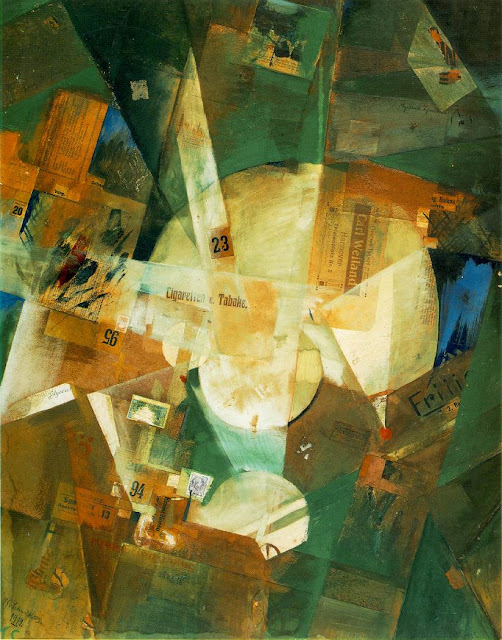


This year also marked the beginning of his friendships with Jean Arp and Raoul Hausmann. Schwitters�s earliest Merzbilder date from 1919, the year of his first exhibition at Der Sturm gallery, Berlin, and the first publication of his writings in the periodical Der Sturm. Schwitters showed at the Soci�t� Anonyme in New York in 1920.
With Arp, he attended the Kongress der Konstructivisten in Weimar in 1922. There Schwitters met Theo van Doesburg, whose De Stijl principles influenced his work. Schwitters�s Dada activities included his Merz-Matineen and Merz-Abende at which he presented his poetry. From 1923 to 1932, he published the magazine Merz. About 1923, the artist started to make his first Merzbau, a fantastic structure he built over a number of years; the Merzbau grew to occupy much of his Hannover studio.

The original Merzbau in Schwitter's Hannover studio
During this period, he also worked in typography. Schwitters was included in the exhibition Abstrakte und surrealistische Malerei und Plastik at the Kunsthaus Zurich in 1929. The artist contributed to the Parisian review Cercle et Carr� in 1930. In 1932 he joined the Paris-based Abstraction-Cr�ation group and wrote for their organ of the same name. He participated in the Cubism and Abstract Art and Fantastic Art, Dada, Surrealism exhibitions of 1936 at the Museum of Modern Art, New York.
The Nazi regime banned Schwitters� work as �degenerate art� in 1937. This year, the artist fled to Lysaker, Norway, where he constructed a second Merzbau. After the German invasion of Norway in 1940, Schwitters escaped to Great Britain, where he was interned for over a year.
He settled in London following his release, but moved to Little Langdale in the Lake District in 1945. There, helped by a stipend from the Museum of Modern Art, he began work on a third Merzbau in 1947. The project was left unfinished when Schwitters died in 1948 in Kendal, England.
Schwitters' London home at 39 Westmorland Road, Barnes.

1919 Bild mit heller Mitte [Picture with Light Centre]
1919 Das Undbild [The And-Picture]
1919 Revolving
1921 Merz 299
1921 Merz 460 Two Underdrawers

1922 Der Weihnachtsmann [Santa Claus]

1922 Merz 410 irgendsowas [Something or Other]
1922 Table Salt
1923 Aphorism

1923 Merz 231 Miss Blanche

1925 Elikan
1928 Untitled

1930 Oorlog
1937-38 Opened by Customs

1938 Die Fruhlingstur [The Spring Door]

1942-43 [Difficult]

1944 [Hitler Gang]

1947 The Holy Night by Antoni Allegri, known as Corregio,
worked through by Kurt Schwitters]
Note: A number of images have been removed by me from this post on possible copyright issues. Poul Webb
Kurt Schwitters - collages
Thought I'd squeeze in a quick in-between post of a few collages I made recently.
A collage may include newspaper clippings, ribbons, bits of coloured or hand-made papers, portions of other artwork, photographs and other found objects, glued to a piece of paper or canvas. The origins of collage can be traced back hundreds of years, but this technique made a dramatic reappearance in the early 20th century as an art form of novelty.
The term collage derives from the French �colle� meaning �glue�.This term was coined by both Georges Braque and Pablo Picasso in the beginning of the 20th century when collage became a distinctive part of modern art.
I had the idea of collaging onto charity shop finds of old 12-inch album covers - I've called the series For the Record. After trawling a number of charity shops for what I thought were 'suitable' covers for the idea, these are the results:


A collage may include newspaper clippings, ribbons, bits of coloured or hand-made papers, portions of other artwork, photographs and other found objects, glued to a piece of paper or canvas. The origins of collage can be traced back hundreds of years, but this technique made a dramatic reappearance in the early 20th century as an art form of novelty.
The term collage derives from the French �colle� meaning �glue�.This term was coined by both Georges Braque and Pablo Picasso in the beginning of the 20th century when collage became a distinctive part of modern art.
I had the idea of collaging onto charity shop finds of old 12-inch album covers - I've called the series For the Record. After trawling a number of charity shops for what I thought were 'suitable' covers for the idea, these are the results:
If I Could Turn Back Time
Life in One Day
Music from the Films
Sacrifice/Healing Hands
Skellern
Spear of Destiny
Who's That Girl
Recent work - collages

�I always need to find some theme, some tangible subject matter besides the paint itself. Otherwise I would have been an abstract artist. I need that hook� something to hang my landscape on� Jim Dine in Jim Dine: Five Themes, 1984
Alan Cristea Gallery, London (2010): Such is Jim Dine�s importance that his work has been celebrated in solo exhibitions from the Guggenheim to the Getty in his native America and in museums in major cities across the length and breadth of Europe over the past 55 years. As he nears his 75th birthday, the demand for his work from institutions and collectors grows ever greater and he still exerts enormous influence over contemporary art practice both here in the UK and abroad.
The �Heart�, one of his most enduring vehicles for his explorations of line and colour and one of his most expressive motifs, will be the common denominator in some 40 recent works, made in his studios in New York and Gottingen, Germany, and on a recent journey to India, which we will exhibit in both of our Cork Street galleries in April and May.
Dine is the Renaissance man of contemporary art � originally performance artist, now at once poet, writer, photographer, sculptor, painter and printmaker.

1982 Rancho Woodcut Heart

1983 Black Heart (lithograph)

1986 Hand Painting on the Mandala

1993 Heart for Film Forum (woodcut)

2007 Dear Senior Boy

2008 Merry Snow

2010 Black Friar's Blues

2010 Blue Birds

2010 Boo-Boo Blues

2010 Manhatten at Home

The Month of June no. 1

The Month of June no.2

The Month of June no. 3

The Month of June no. 4

The Month of June no. 6

The Month of June no. 9

The Month of June no. 10
Note: A number of images have been removed by me from this post on possible copyright issues. Poul Webb
Jim Dine III � hearts
Langganan:
Postingan
(
Atom
)


