Sigmar Polke (1941 � 2010) was born in Oels, Silesia. In 1953 he moved from Thuringia to D�sseldorf where he began an apprenticeship as a glass-painter in 1959. Between 1961-1967 he studied at the D�sseldorf Art Academy
Over the past 40 years Polke created complex works that have helped define the art of the time. In the 1960s he created a new and unique vision of German art, which during the postwar years had been largely derivative of gestural abstraction. During this time Polke began making his �dot� paintings, manually executed parodies of the Benday dot screens used by Roy Lichtenstein and Andy Warhol.
Although he shared visual ideas with American Pop artists, he was less concerned with appropriating the pictorial style of advertising than in depicting the desired objects of a consumer society. While at the Kunstakademie D�sseldorf in 1963, Polke and fellow students Konrad Lueg and Gerhard Richter consolidated their ideas of cultural criticism into a style they termed Capitalist Realism. The humorous and deliberately �unskilled� qualities of Polke�s earliest works formalized a critique of both Socialist Realism and Pop art.
During the 1970s, Polke slowed his art production in favour of travel to Afghanistan, Brazil, France, Pakistan, and the U.S., where he shot photographs and film footage that he would incorporate in his subsequent works during the 1980s. Using materials such as sheer synthetic fabrics, coloured lacquers, and hydrosensitive chemicals in combination with paint, he began to self-consciously undermine the conventions of painting and to challenge its appropriateness as a medium to comment on contemporary life.
Kathreiners Morgenlatte, with its layered composition incorporating fabric and painted imagery, is an example of this questioning. An image of a dull, domestic interior is superimposed over patterned swatches and clippings culled from the mass media, creating a formal metaphor for the complex layering of ideas found in postmodernism. To underscore his �destruction� of the traditional easel painting, Polke has apparently taken the wooden stretcher, cut it up and strewn the pieces over the surface of the work. Inverting his own name but signing �Henri Matisse� right side up, Polke ironically comments on the presumed necessity of including an accepted sign of high modernism in order to guarantee the authenticity and value of an artwork. By reconciling a complex group of references in Kathreiners Morgenlatte, Polke presents a critique of the condition of the artist and the impossibility of a sustained originality in contemporary art in the late 20th century.
The anarchistic element of the work Polke developed was largely engendered by his mercurial approach. His irreverence for traditional painting techniques and materials and his lack of allegiance to any one mode of representation has established his now-respected reputation as a visual revolutionary.
Paganini, an expression of "the difficulty of purging the demons of Nazism" - witness the "hidden" swastikas - is typical of Polke's tendency to accumulate a range of different mediums within one canvas. It is not unusual for Polke to combine household materials and paint, lacquers, pigments, screen print and transparent sheeting in one piece. A complicated "narrative" is often implicit in the multi-layered picture, giving the effect of witnessing the projection of a hallucination or dream through a series of veils.
Sigmar Polke died in 2010 in Cologne. There will be further examples of Polke's work in the next post.
Over the past 40 years Polke created complex works that have helped define the art of the time. In the 1960s he created a new and unique vision of German art, which during the postwar years had been largely derivative of gestural abstraction. During this time Polke began making his �dot� paintings, manually executed parodies of the Benday dot screens used by Roy Lichtenstein and Andy Warhol.
 |
| 1968 Don Quixote |
 |
| 1965 Liebespaar II |
 |
| Kathreiners Morgenlatte |
The anarchistic element of the work Polke developed was largely engendered by his mercurial approach. His irreverence for traditional painting techniques and materials and his lack of allegiance to any one mode of representation has established his now-respected reputation as a visual revolutionary.
 |
| 1981-93 Paganini |
Sigmar Polke died in 2010 in Cologne. There will be further examples of Polke's work in the next post.
 |
| 1964 Two Palm trees |
 |
| 1965-66 Freundinnen |
 |
| 1966 Woman at the Mirror |
 |
| 1968 Heron Painting II |
 |
| 1971-73 Zwei Kopfe |
 |
| 1973 Original + Fa�lschung |
 |
| 1976 Kandinsdingsda (Wir Kleinbu�rger) |
 |
| 1982 Hannibal with his Armoured Elephants |
 |
| 1982 Magnetic Landscape |
 |
| 1982 This is how you Sit Correctly (After Goya) |
 |
| 1983 Lingua tertii Imperii |
 |
| 1986 Audacia |
 |
| 1987 B-mode |
 |
| 1988 Nude |
 |
| 1989 Untitled |
Sigmar Polke - Part 1
This is the second part of a post on Bridget Riley, and shows examples of her colour work, which began in 1967. For background and biographical information on Riley see Part 1.
 | ||||
| 1967-8 Late Morning (pva emulsion) |
 |
| 1970 Circles Colour Structure Studies |
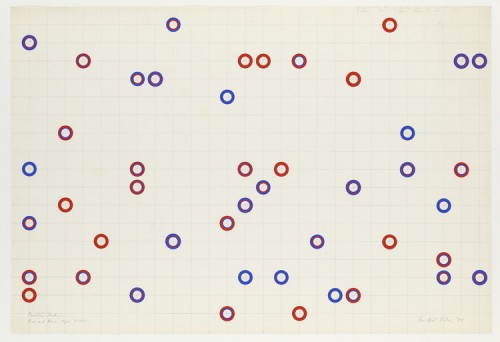 |
| 1970 Circles Colour Structure Studies |
 |
| 1970 Circles Colour Structure Studies |
 |
| 197 Circles Colour Structure Studies |
 |
| 1970 Orient 4 (acrylic) |
 |
| 1972-3 Cantus Firmus (acylic) |
 |
| 1973 Paean (acrylic) |
 |
| 1978 Aurulum |
 |
| 1981 Ach�an (oil) |
 |
| 1981 Light Between (screenprint) |
 |
| 1981 Shade (oil) |
 |
| 1981-2 Big Blue (oil) |
 |
| 1984 Blue Return (oil) |
 |
| 1987 Ease |
 |
| 1999 Fete (screenprint) |
 |
| 1999 Going Along (oil) |
 |
| 2000 Echo (screenprint) |
 |
| 2000 Start (screenprint) |
Bridget Riley - Op Art part 2
Bridget Riley is one of Britain�s best-known artists whose career has spanned over 50 years. She first came to notice in the early 1960s with monochrome paintings that explored the dynamics of optical effects.
�In my earlier paintings, I wanted the space between the picture plane and the spectator to be active. It was in that space, paradoxically, the painting 'took place�then, little by little, and, to some extent deliberately, I made it go the other way, opening up an interior space, as it were, so that there was a layered, shallow depth. It is important that the painting can be inhabited, so that the mind's eye, or the eye's mind, can move about it credibly."
In 1967 Riley began experimenting with colour, and since then her paintings have examined the perception of nature by means of colour and form.
�The eye can travel over the surface in a way parallel to the way it moves over nature. It should feel caressed and soothed, experience frictions and ruptures, glide and drift�one moment there will be nothing to look at and the next second the canvas seems to refill, to be crowded with visual events.�
Riley was born in London in 1931 and was brought up in Cornwall. She studied at Goldsmiths College between 1949 � 1952 and the Royal College of Art between 1952 � 1955. In 1969 she was the first woman to win the International Prize for Painting whilst representing Britain at the 34th Venice Biennale.
She holds honorary doctorates from Oxford University, 1994, and Cambridge University, 1995. She was made a CBE in 1974 and in 1999 was awarded the Companion of Honour. In 2009 she was awarded the Kaiser Ring of the City of Goslar, Germany, one of the world�s most prestigious art prizes. Major exhibitions have included the Hayward Gallery, 1970 and 1992/94; a British Council touring retrospective in the USA, Australia and Japan, 1979; and retrospective exhibitions at Tate Britain, 2003; Museum of Modern Art in Sydney, Australia, 2005; City Gallery Wellington, New Zealand, 2005; and Musee d�Art Moderne de la Ville de Paris, 2008. She lives and works in London, Cornwall and France.
Part 1 is showing a selection of Riley's work from between 1961 and 1967.
�In my earlier paintings, I wanted the space between the picture plane and the spectator to be active. It was in that space, paradoxically, the painting 'took place�then, little by little, and, to some extent deliberately, I made it go the other way, opening up an interior space, as it were, so that there was a layered, shallow depth. It is important that the painting can be inhabited, so that the mind's eye, or the eye's mind, can move about it credibly."
In 1967 Riley began experimenting with colour, and since then her paintings have examined the perception of nature by means of colour and form.
�The eye can travel over the surface in a way parallel to the way it moves over nature. It should feel caressed and soothed, experience frictions and ruptures, glide and drift�one moment there will be nothing to look at and the next second the canvas seems to refill, to be crowded with visual events.�
Riley was born in London in 1931 and was brought up in Cornwall. She studied at Goldsmiths College between 1949 � 1952 and the Royal College of Art between 1952 � 1955. In 1969 she was the first woman to win the International Prize for Painting whilst representing Britain at the 34th Venice Biennale.
She holds honorary doctorates from Oxford University, 1994, and Cambridge University, 1995. She was made a CBE in 1974 and in 1999 was awarded the Companion of Honour. In 2009 she was awarded the Kaiser Ring of the City of Goslar, Germany, one of the world�s most prestigious art prizes. Major exhibitions have included the Hayward Gallery, 1970 and 1992/94; a British Council touring retrospective in the USA, Australia and Japan, 1979; and retrospective exhibitions at Tate Britain, 2003; Museum of Modern Art in Sydney, Australia, 2005; City Gallery Wellington, New Zealand, 2005; and Musee d�Art Moderne de la Ville de Paris, 2008. She lives and works in London, Cornwall and France.
Part 1 is showing a selection of Riley's work from between 1961 and 1967.
 |
| 1961 Kiss (acrylic) |
 |
| 1962 Blaze I (emulsion) |
 |
| 1963 Fall (emulsion) |
 |
| 1964 Hesitate (oil) |
 |
| 1964 Intake (acrylic) |
 |
| 1964 Loss (oil) |
 |
| 1964 White Disks (emulsion) |
 |
| 1965 Arrest III (acrylic) |
 |
| 1965 Arrest I (emulsion) |
 |
| 1965 Descending (emulsion) |
 |
| 1965 Fragment 2/10 (screenprint on perspex) |
 |
| 1966 Breathe (emulsion) |
 |
| 1966 Static 2 (emulsion) |
 |
| 1966 Untitled, Diagonal Curve (emulsion) |
 |
| 1967 Cataract 3 (pva emulsion) |
 |
| 1967 Deny II (pva emulsion) |
Bridget Riley - Op Art part 1
Langganan:
Postingan
(
Atom
)


